What it is
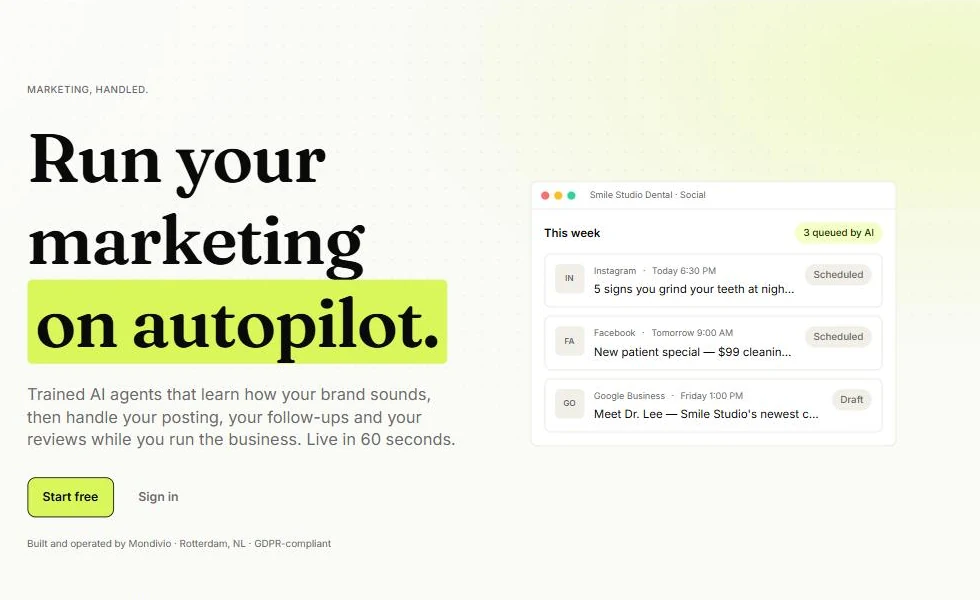
A small business does not have a content-calendar problem. It has a nobody-owns-this problem. IntellyPilot is built for that gap: it reads the brand once, proposes a plan, drafts the posts and the emails, produces the imagery, schedules everything across whichever channels the business actually uses, captures the leads that come back and reports afterwards on what worked.
Twenty modules behind one login, including a content studio, a media studio, a calendar, social publishing, email sequences, CRM, leads, reviews, Google Business Profile, competitor tracking and attribution. Fifteen of the publishing channels are separate integrations, each with its own approval process to clear before a single post can be sent. English and Dutch throughout.
The commercial problem
Connecting a language model to a text box is a day's work. The difficulty arrives a month later, on the invoice.
AI requests cost real money, and the heaviest users cost the most. A flat subscription loses money on exactly the customers you most want to keep. Billing per action instead leaves the customer unable to predict what they owe, and a blunt usage cap breaks the product at the moment somebody starts getting value from it.
We built the accounting before the features. Every request is measured and converted into credits at a published rate, drawn against a monthly allowance the customer can watch as it moves. Routine internal work is handled by a smaller, cheaper model automatically, because there is no reason to pay a premium rate to decide whether a sentence is a question. And because the credit ledger is ours rather than the payment provider's, we can make onboarding free without inventing a separate product to do it.
The result is a price we can quote with confidence and a bill the customer can predict. Neither of those is a feature anybody asks for, and both decide whether the business works.
Two decisions
An assistant inside the product, not a connector to someone else's
The cheaper option was to expose the platform to outside AI assistants and let customers drive it from whichever one they already use. It costs less to build, and it moves the AI bill onto their subscription instead of ours.
We built the assistant inside the product instead. The customers this platform exists for — a physiotherapist, a gym, an estate agent — are not running an AI assistant of their own and are not about to start. Making that the main way in would have served a technical minority and left out everyone the product was written for. The connector shipped later as well, for the few who want it.
Nothing goes out without a person agreeing to it
The assistant's abilities are separated by whether their effects can be undone. Reading and drafting happen immediately: fetch the calendar, look up which posts performed best, write five drafts. The worst outcome is a draft nobody uses.
Anything that reaches the outside world behaves differently. It cannot act at all. It returns a proposal, the interface shows it as a preview, and nothing happens until somebody presses Confirm.
Nothing is published on a customer's behalf without a person agreeing to it first.
Scheduling a week of posts, changing the business profile, cancelling a queue: each returns a proposal rather than a result. That separation is built into what the assistant is able to do, rather than written down as a policy and hoped for.What it includes
| Planning | A marketing plan derived from the business itself, with a calendar and a weekly view of what is scheduled |
|---|---|
| Creation | Posts, carousels, advertising creative, email copy and imagery, written in the customer's own voice rather than a generic one |
| Publishing | Fifteen channels, scheduled and published automatically, with approval before anything goes out |
| Follow-up | Lead capture, CRM with a pipeline, email sequences, review requests and WhatsApp |
| Measurement | Performance by channel and by post, competitor tracking, and attribution from first touch to conversion |
| Knowledge | A document library per workspace that the writing draws on, so answers and copy reflect the customer's own material |
| Teams | Workspaces, seats, roles and invitations, with approval steps where a business wants them |
| Commercial | A free tier and three paid plans from €39 to €499 per month, each with a monthly AI allowance |
| Compliance | Data export and deletion available directly in the product rather than by request |
The audits
Four review rounds before launch, each one deliberately adversarial. Two of the findings are worth setting out.
A platform that assembles imagery has to fetch things on the customer's behalf: a logo from a web address, a stock backdrop, a linked asset. Each of those is our own system reaching out to an address somebody else supplied.
That is a well-known category of vulnerability, and once we counted how many places did it, there were more than we were comfortable with. All outbound requests now pass through a single checked route, and the entry point used by outside assistants was tightened in the same round.
The pricing pages showed dollars. The checkout charged euros.
Nobody was overcharged and the payment itself was correct throughout, but for a period we were quoting one currency and billing in another. We corrected the pricing page, then found the same error on every sector landing page and corrected those too.
Of everything in this product, the item that came closest to costing us a customer's confidence was a currency symbol.
The same rounds caught smaller things: free stock imagery drawing down an AI allowance it should never have touched, accessibility gaps in a new screen, and places where a failure could go unreported. All of it was found before a customer had to report it.
Where it stands
| Status | Live at intellypilot.com, with a free tier and three paid plans |
|---|---|
| Ownership | Built, funded and operated by Mondivio. No client brief and no investor |
| Why it is here | It is the one system where we are also the customer, and have to live with our own decisions |
Similar work
If you are putting AI in front of paying customers, the model is the straightforward part. What decides whether it works as a business is everything around it: what each request costs, what happens when the allowance runs out, who approves something before it goes out under your name, and whether the bill still makes sense at the end of the month. We have built that once, with our own money.